








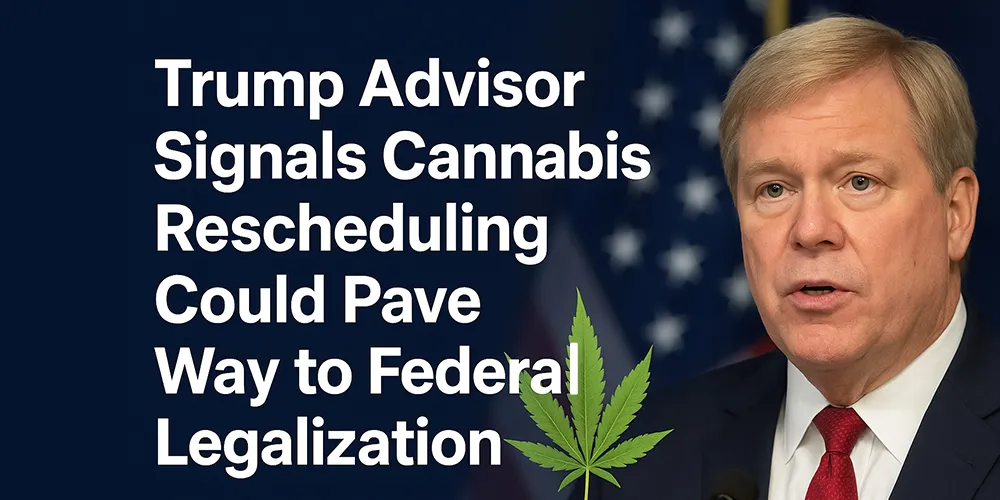
A senior advisor to President Donald Trump is signaling that the administration may take a major step toward reforming U.S. marijuana policy—rescheduling cannabis under the Controlled Substances Act (CSA). The move, if enacted, would mark the most significant federal shift on marijuana in over half a century and could serve as a bridge toward eventual legalization.
According to reports emerging on August 29, 2025, the Trump advisor emphasized that rescheduling cannabis from Schedule I—where it sits alongside heroin and LSD—to a lower classification would acknowledge its recognized medical use while reducing barriers for research and industry growth.
Currently, Schedule I drugs are defined as having “no accepted medical use” and “a high potential for abuse.” Marijuana’s placement there has long been criticized by lawmakers, scientists, and industry leaders who point to its proven therapeutic benefits and widespread state-level legalization.
If cannabis is rescheduled to Schedule III or lower, it would remain federally controlled but no longer treated as a substance with no medical value. This shift would ease restrictions on research, allow for more medical applications, and potentially unlock tax relief for cannabis businesses currently barred from federal deductions under IRS code 280E.
Rescheduling cannabis would not, on its own, create a legal nationwide market—but it would significantly alter the legal and economic landscape:
The Trump administration’s posture contrasts with previous years of gridlock, and it places the president in the middle of a national debate where nearly 70% of Americans support full legalization.
For Republicans, rescheduling may offer a compromise—acknowledging science and easing burdens on businesses without fully embracing legalization. For Democrats, many of whom favor comprehensive legalization, rescheduling could be seen as a half-measure but still a step in the right direction.
The cannabis industry is already reacting. Analysts suggest that rescheduling could drive investor confidence and boost valuations, especially for publicly traded U.S. operators. Meanwhile, legalization advocates caution that rescheduling without full decriminalization could leave communities disproportionately harmed by prohibition behind.
This latest development comes as Democratic lawmakers, led by Representative Jerrold Nadler, have reintroduced the MORE Act, which seeks to legalize marijuana at the federal level, expunge criminal records, and reinvest in communities impacted by the drug war.
The two tracks—Trump’s rescheduling push and Democrats’ legalization push—set up a high-stakes policy clash heading into 2026. The question remains: will rescheduling be enough to satisfy public demand, or will it merely set the stage for a broader legislative battle?
If the Trump administration moves forward with rescheduling, the Department of Justice and DEA would need to initiate a formal rulemaking process, including public comment and scientific review. The timeline could extend months or even years, meaning rescheduling might not be finalized before the next election cycle.
Still, the signal alone is a powerful indicator that Washington is finally preparing to break with decades of prohibitionist policy.








 Bulk Marijuana Seeds offers high-germination rates of marijuana seeds while keeping you assured that you will be getting the exact Marijuana Strain that you ordered! That is 100% Guaranteed!
 Bulk Marijuana Seeds offers high-germination rates of marijuana seeds while keeping you assured that you will be getting the exact Marijuana Strain that you ordered! That is 100% Guaranteed!